


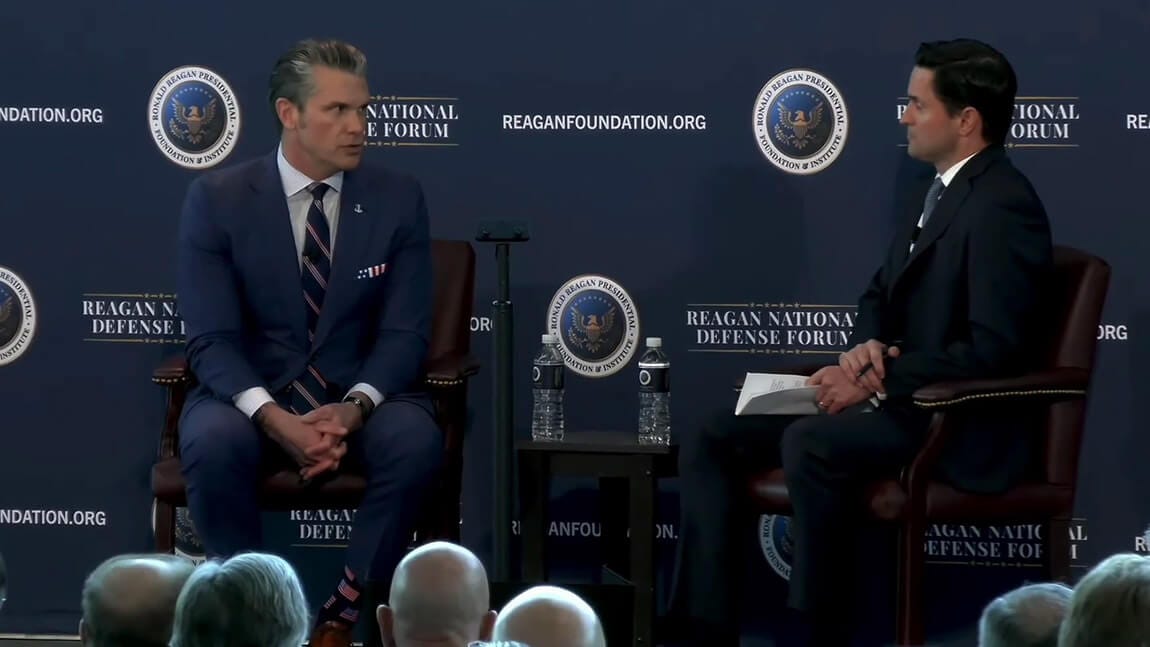
The Ronald Reagan Institute held its annual National Defense Forum this weekend in Simi Valley, California. Its keynote speaker on Saturday was U.S. Defense Secretary Pete Hegseth, also known as the “Secretary of War.”
After his speech—which “represented a preview of the War Department’s forthcoming National Defense Strategy,” according to a Pentagon official quoted on the DoD’s official website—Hegseth took part in a Q&A session dubbed the “keynote conversation.”
“Would you rather see your soldiers, Marines, on the front lines armed with more AI capability, or have them replaced with autonomous systems?” he was asked near the end of the session.
“I think it’s gonna be both,” Hegseth replied. “I mean you watch the modern battlefield, it has to be both.”
“Autonomy is—we see it in Ukraine, we see it elsewhere, we’re learning from that, the Army’s learning from that—is a huge part of the way of the future,” Hegseth said a moment later. “So it’s definitely gonna be both.”
Watch:
As we recently reported, transhumanist billionaire Elon Musk, a major Pentagon contractor, said at a Tesla shareholders meeting last month that AI is ultimately going to be “in charge” of society, “not humans,” while discussing his plans to produce “tens of billions” of humanoid robots.
“Obviously it’s very important we pay attention to safety here,” Musk said, “cause uhh, we do—we do want the Star Wars movie, not the Jim Cameron movie,” presumably a reference to Cameron’s 1984 sci-fi film The Terminator.
Hegseth, for his part, also posted a video on Saturday that shows him meeting with DoD contractors like Anduril’s Palmer Luckey, who says his company’s tech will make US soldiers—at least the ones who aren’t “replaced” by autonomous systems—into “unstoppable technomancers.”
“We are rebuilding the Arsenal of Freedom,” Hegseth wrote.
Autonomy by Anduril
Besides its high-tech headgear, Aundril is also ”one of the main beneficiaries of government contracts to build autonomous surveillance towers along the US-Mexico border,” and has received DoD contracts to supply the military “with autonomous aircraft, such as its Ghost platform and autonomous underwater vehicles,” to quote from a deep-dive article published by journalist Whitney Webb last year.
“Like the drones that interface with their surveillance towers on the border,” these autonomous systems are, per Webb, “framed as useful for surveillance and reconnaissance, but are also able to deliver payloads, i.e. they are able to be outfitted with weapons of war.”
Anduril has also been “developing weapon systems that appear to fall under the controversial category of autonomous weapons,” she writes, “meaning that the unmanned device could kill without meaningful human oversight.”
“These drones utilize Lattice, the same AI-enabled operating system as those that run Anduril’s border towers and surveillance drones. [In 2023], Anduril unveiled a new version of Lattice that ‘is designed to foster dynamic collaboration among autonomous systems,’ e.g. allowing surveillance drones/towers and weaponized ones to be interoperable and conduct missions together without necessarily needing a human to coordinate them.”
More recently, the company has had a number of failures and “setbacks”—namely “breakdowns and safety issues” with their products, according to documents reviewed by the Wall Street Journal for a newly-published report (archived here).
As summarized by TechCrunch:
The problems cited include more than a dozen drone boats that failed during a Navy exercise off the California coast in May, with sailors warning of safety violations and potential loss of life; a mechanical issue that damaged the engine of Anduril’s unmanned jet fighter Fury during a summer ground test; and an August test of its Anvil counter-drone system that caused a 22-acre fire in Oregon. (…) Beyond testing failures, the Journal reports that Anduril’s only real battlefield experience in Ukraine has also been problematic. Front-line soldiers with Ukraine’s SBU security service found that [Anduril’s] Altius loitering drones crashed and failed to hit targets. The issues were reportedly severe enough that Ukrainian forces stopped using the drones in 2024 and haven’t fielded them since, though Anduril maintains that its challenges are typical of weapons development, that its engineering team is achieving meaningful progress, and that the aforementioned incidents don’t indicate any underlying flaws in its technology.
Theil-Connected
As far as Palmer Luckey’s backstory, an abridged version includes the fact that he is, per Webb, “a long-time associate of Palantir co-founder Peter Thiel, having met Thiel at 19 when Luckey presided over his first company Oculus Rift, which was later sold to Facebook.”
Thiel was on Facebooks board at the time, she notes, and was also “instrumental in the rise of the social media company.”
“Luckey’s Anduril is also backed by Thiel’s Founders Fund and another Palantir co-founder, Joe Lonsdale, is also an Anduril investor.”
Per Webb, Anduril “would not exist without the assistance of Thiel and several executives from Thiel’s Palantir,” the former of whom also played a major role in the career of vice president JD Vance:
“The potential dangers of Anduril can only fully be fleshed out when considering the family of Thiel-backed defense/intelligence companies as a whole,” Webb argues, before going on to provide an overview.
‘Facing The Unthinkable’
The perils of autonomous weapons systems have been highlighted for years by a wide range of human rights and watchdogs groups.
The Future of Life Institute, for instance, called for “a ban on offensive autonomous weapons beyond meaningful human control” a full decade ago, warning of a “military AI arms race.” Today, they’re more blunt: “Slaughterbots are here,” they write. “The era in which algorithms decide who lives and who dies is upon us. We must act now to prohibit and regulate these weapons.”
The International Committee of the Red Cross‘ official position is that “humans must maintain control over life-and-death decisions,” and that states should adopt “new, international legally binding rules to prohibit unpredictable autonomous weapons and those designed or used to apply force against persons, and to place strict restrictions on all others.”
UN Secretary-General António Guterres has called lethal autonomous weapons systems “politically unacceptable and morally repugnant,” and advocated for their prohibition under international law.
Human Rights Watch published a paper with Harvard’s International Human Rights Clinic which warned that “autonomous weapons systems pose grave risks to human rights during both war and peacetime” and stressed the “urgent need” for a “multinational treaty.”
Many of the other groups opposing such systems have coalesced as part of the Stop Killer Robots campaign, whose 250+ member organizations from over 70 countries includes International Peace Bureau, Nuclear Age Peace Foundation, World Council of Churches, Parliamentarians for Global Action, and Code Pink, just to name a few.
Amnesty International, another member organization, described the situation as follows:
We are facing the unthinkable: drones and other advanced weapons are being developed with the ability to choose and attack their own targets – without human control. Once thought to be in movies, autonomous weapons, or ‘killer robots’, are not a future problem any more.
Machines can’t make complex ethical choices. They lack compassion and understanding, they make decisions based on biased, flawed and oppressive processes. Emerging technologies like facial and vocal recognition often fail in recognizing women, people of colour and persons with disabilities. This means that autonomous weapons can never be adequately programmed to substitute human decision making.
The replacement of troops with machines makes the decision to go to war easier – and through illegal transfers and battlefield capture, these weapons will fall into hands of others. What’s more, these technologies will be used in policing, in border control, and to threaten human rights like the right to protest, the right to life, the prohibition of torture and other ill treatment. Despite these concerns, countries like the US, China, Israel, South Korea, Russia, Australia, India and the UK continue to invest in autonomous weapons.
As companies and defence departments around the world race to develop these technologies, we must act fast before we lose meaningful human control over the use of force – with devastating consequences.
Decensored News is an independent, reader-supported publication. If you value our work, please help us grow and produce more of it with a monthly or one-time contribution. This story was originally published at decensored.news. For more reporting like this, follow us on multiple platforms, bookmark the website, and subscribe here on Substack: